
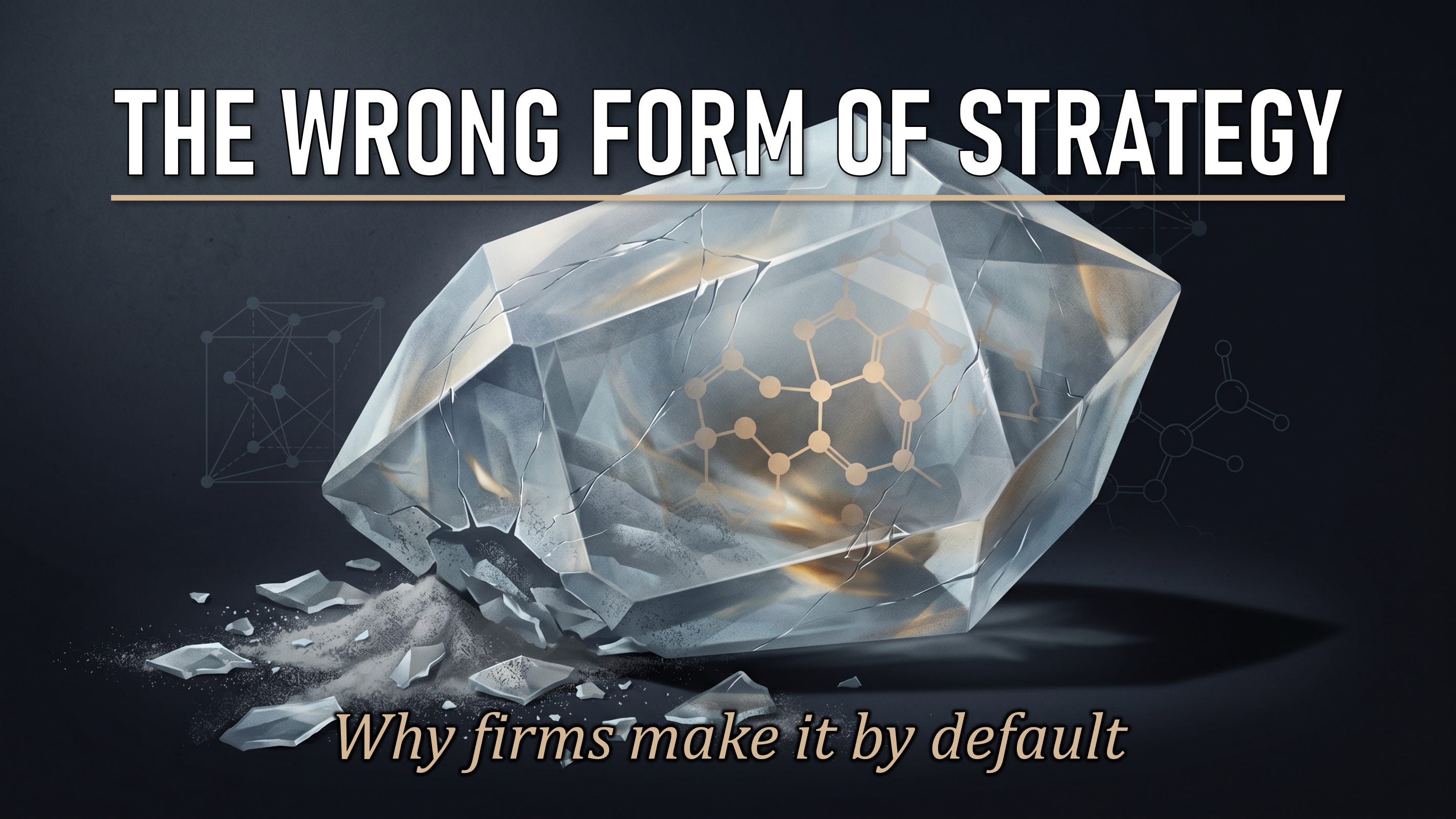
The Wrong Form of Strategy
Why firms make it by default

I. The Boardroom Question
A few months ago, in a boardroom in São Paulo, I once again watched something I have been seeing for twenty years.
The CEO had just finished presenting the strategy. The presentation was excellent. Ambition, market maps, target segments. Where to Play, How to Win, Capabilities. Roadmap, OKRs, KPIs.
The slides were polished. The font was the right font. The board approved it.
Walking out, the CSO turned to me and asked, “What did we just actually decide?”
Neither of us could answer cleanly. We could repeat the words. We could not say what clear differentiated bet had been placed.
Twenty years of strategy work, across Bain, BCG, Strategy&, Accenture, operating roles, and freelance advisory. The same scene plays out in different rooms, different cities, different industries. Sometimes in Portuguese, sometimes in English. The shape is the same. The presentation is excellent. The decision is unclear.
The strategy field is not short on good writing. Michael Porter on uncopyable position. Richard Rumelt on diagnosis, guiding policy, and coherent action. Roger L. Martin on the choice cascade. Hamilton Helmer on the seven kinds of barrier-protected advantage. Schelling, Boyd, Ghemawat, Luttwak, Brandenburger and Nalebuff on how strategy survives contact with adaptive others. The bookshelf is excellent. The literature has been clear for decades.
And yet most strategy work in most organizations does not look like any of it.
The presentations contain the words. They do not contain the structure.
Why does the literature not percolate?
II. False Starts
I tried the obvious explanations.
I tried “executives are stupid.” It does not fit. Most are not. The same executives who produce hollow strategy slides make sharp decisions about pricing, hiring, capital allocation, and personnel. They are intelligent on every other dimension of management.
I tried “consultants work in bad faith.” It does not fit either. I have worked alongside extraordinarily capable consultants who produced both genuine strategy and faux strategy in the same year, in the same firm, sometimes even for the same client.
I tried “strategy is hard.” Closer. Still wrong. Strategy is hard. That truth does not explain why even sophisticated firms with everything they need produce slides that contain the right vocabulary and do absolutely nothing strategic.
The gap underneath all these explanations: each asked whether something in the process or ingredients made the artifact good or bad. None asked whether two artifacts that looked incredibly similar at the surface could be radically different beneath.
Same templates. Same frameworks. Two forms of strategy.
I needed a mental model where the same surface form could hide different structures. Then, last week, I watched a video about chemistry on YouTube.
III. The Disappearing Drug
The video is a Veritasium piece titled The Disaster I Never Imagined Having to Worry About. The title makes it feel like a disaster movie. I clicked and watched it twice. What follows is the science of it, summarized. My interpretation comes after.
In 1996, the pharmaceutical company Abbott introduced a drug called Ritonavir. It was a protease inhibitor that turned HIV from a death sentence into a manageable condition. By 1998, seventy-five thousand patients in the United States were on the drug, taking up to twenty capsules a day. Two years of clean production. Two hundred and forty consecutive batches passed Abbott’s dissolution testing protocol.
Then in mid-1998, an analyst at the Chicago plant noticed a capsule had not dissolved properly. Protocol shutdown. Batch destroyed. Production line cleaned.
The next day, the same thing happened. Within a week, every capsule produced by both the Chicago factory and the research lab was failing.
Abbott checked everything. Inputs, temperatures, humidity, weights, procedures. Everything matched what they had been doing for two years. They could not find a cause.
They opened a new factory in Italy. Production started cleanly. Every pill passed. Relief.
A team of Chicago scientists flew to Italy to compare what the Italians were doing differently. They found no difference. Within days of their visit, an Italian capsule failed dissolution. Then more. Within weeks, every facility on Earth that produced the drug was contaminated. The Abbott scientist who led the response said it plainly later: they did not know how to detect it, test for it, prevent it, or get rid of it.
The cause was a second crystalline form of the same molecule, more thermodynamically stable than the original, that had appeared in the Chicago plant and propagated. They named it Form 2. The original drug had been Form 1. Identical molecular formulas. Different packing in the solid state. Form 2 was so much more stable that, once present in a facility, it spread through seed crystals carried on people’s clothes, on equipment, in the air.
The puzzle has older roots. In the 1820s, the chemist Justus von Liebig was reading a paper by Friedrich Wöhler describing a beige powder: one silver, one carbon, one nitrogen, one oxygen atom. Liebig had himself just discovered a compound with the exact same molecular formula, except his exploded violently when heated. Wöhler’s was nearly inert. Same atoms. Same proportions. Different behavior. The dispute, eventually resolved in collaboration, became one of the founding moments of structural chemistry. Composition does not determine behavior. Arrangement does.
The phenomenon also appears in pure metals. Tin exists in two solid forms. Above 13°C, the metallic form humans have used for thousands of years: white tin, ductile, conductive, useful. Below 13°C, it slowly converts into a brittle gray powder. The transformation is contagious. A single grain of gray tin in contact with metallic tin lowers the activation energy for the rest. The gray form spreads. It used to destroy tin organ pipes in unheated European cathedrals during cold winters. The metal would visibly powder. The phenomenon has a name: tin pest.
Both forms of tin are pure tin. The same atoms. A different arrangement. A different material entirely. White tin holds organ pipes upright for centuries. Gray tin is dust.
The phenomenon, across all these cases, has a name. Polymorphism is the ability of a solid substance to exist in multiple forms with the same molecular composition. Different forms can differ in melting point, solubility, density, hardness, conductivity, and stability. In pharmaceuticals, the difference can determine whether a drug is bioavailable. In metals, the difference can determine whether a structure holds.
Some forms are more stable than others under prevailing conditions. Once a more stable form appears, seed crystals of it lower the activation energy for new material to crystallize the same way. The form spreads. Once it dominates an environment, the original form may be impossible to nucleate again. The technical name is disappearing polymorph.
Abbott’s chemists could not bring back Form 1. They abandoned the capsule formulation and switched to a liquid one with worse side effects but reliable manufacture. The Abbott scientist who led the response held a press conference five months in. A reporter asked how a large company with smart scientists could let this happen. He answered cleanly:
Company size and the collective IQs of the scientists have no relationship to this problem.
The Veritasium video lays out all of this with great footage and demonstrations. The full piece runs thirty-three minutes. It even explains chocolate! Watch it before continuing, if you can.
IV. Exploiting Analogy
The second time I watched the video, I could not stop thinking about strategy.
Roger Martin says that analogy is a key skill of strategy. Now think about genuine strategy vs faux strategy:
The same molecular formula. Mission. Vision. Ambition. Market analysis. Customer segments. Where to Play. How to Win. Capabilities. Roadmap. OKRs. KPIs. Operating model.
Two strategy presentations can contain those words in the same configuration and represent radically different compounds beneath.
Strategy artifacts are polymorphic.
The same vocabulary, the same artifacts, the same structure can be forged into a coherent alloy or crystallize into a brittle crystal.
The coherent alloy is what genuine strategy looks like beneath the surface: multiple choices and sacrifices fused together such that each one reinforces the others, the whole stronger than the sum, hard to make and harder to copy.
The brittle crystal is what faux strategy looks like beneath the surface: the same vocabulary aggregated into a structure that looks uniform from outside and breaks under any pressure that matters.
Same elements. Different bonds. Different fate.
This analogy explains twenty years of in-field observation. Faux strategy is not failed strategy. Faux strategy is strategy language that has crystallized rather than alloyed.
And it raised the obvious next question. If both forms use the same vocabulary, what are the bonds that distinguish them?
V. The Two Lattices
Genuine strategy is a coherent alloy. Several load-bearing components, fused into one structure:
Diagnosis: a sharp reading of the actual situation, naming the crux of difficulty rather than its symptoms.
Customer Compulsion: a defensible reason a particular customer should choose this firm rather than route around it.
Barrier Proof: a credible mechanism that makes imitation slow, expensive, or uncertain.
Adaptive Response Logic: an explicit theory of what competitors will do when this works, and how the firm will respond.
Sacrifice: specific attractive things the firm refuses to do, specific customers it will not serve, specific products it will not build, specific geographies it will not enter.
Activity-System Fit: operational choices that reinforce each other so no single one can be copied profitably in isolation.
Falsifiability: the conditions under which the firm would know it was wrong.
These components are mutually load-bearing. Remove one and the structure weakens dramatically. Remove two and the structure is no longer a strategy. The alloy gets its strength from the bonds between components, not from any component alone.
This is just like metallurgy: bronze is harder than copper because tin atoms wedge into the copper lattice and pin dislocations. Steel is harder than iron because carbon does the same. Strategy works the same way. Each choice constrains and reinforces the others. The constraint is what produces the strength.
Faux strategy is a structure made from the same surface vocabulary. But its components are different:
Motivational Aspiration: statements of intent without specific sacrifice attached to them.
Stakeholder Inclusion: every internal constituency gets a piece, buy-in for everyone, no one is told no.
Benchmarking Parity: peer comparisons treated as targets, the firm aiming to converge on what comparable firms already do.
Planning Comfort: initiatives with budgets, owners, and timelines, listed and presented as if they were strategic choices.
Scope Proliferation: many small bets spread across the organization and the calendar rather than concentrated commitments.
Metric Substitution: OKRs and KPIs that measure activity rather than strategic outcomes, generating motion rather than asymmetry.
Accountability Diffusion: no specific person is on the hook for whether the strategy as a whole works.
These components do not fuse. They aggregate. The brittle crystal looks uniform from outside and consists, beneath the surface, of pieces that touch but do not bond.
Both structures can use the same vocabulary on the surface. Both can contain ambition, where-to-play, how-to-win, capabilities, OKRs. Both can survive a fluent walkthrough.
The properties differ. Genuine strategy produces customer compulsion, asymmetric returns, durable advantage, and the consistent rejection of attractive alternatives. Faux strategy produces alignment, comfort, the illusion of certainty, operational motion, board legibility, and the consistent inclusion of any attractive alternatives.
Surface inspection cannot distinguish them reliably at high polish. Both can produce a smart-sounding executive summary. Both can be presented in the same forty-five minute board slot. The diagnostic difference is structural: which components are load-bearing, which are decorative, which have been replaced.
But describing the two structures does not explain why one forms so much more easily than the other. If both use the same vocabulary, why does the crystal nucleate by default while the alloy requires deliberate forging?
VI. Why the Crystal Wins
A polymorph is favored when it has lower activation energy and lower free energy under the prevailing conditions. The form that nucleates first and grows fastest is the form that wins, even when a more functional form exists. White tin is the better material; gray tin is the more thermodynamically stable form below 13°C. The more functional form is not the favored form. The favored form is the one nature reaches with less effort.
Strategy’s brittle crystal has lower activation energy on every dimension that matters in an organization:
Lower cognitive energy. The crystal assembles from templates. Every senior manager has seen the format. The vocabulary is portable. It can be produced in days from an off-the-shelf framework.
Lower social energy. The crystal includes everyone. It does not name losers inside the firm. It does not tell powerful executives that their pet projects are not strategic. It does not require anyone to give up territory. It is consensus-shaped.
Lower managerial energy. The crystal translates cleanly into PMO machinery. Initiatives, owners, budgets, milestones. It is operationally legible because it consists of lists rather than a coherent argument.
Lower commercial energy. The crystal is easier to sell. It can be delivered, shiny and polished, in a known number of weeks. An internal strategy team can produce it on the planning calendar. It fits the budgeting cycle and the board calendar without disturbance.
Lower political energy. The crystal is not falsifiable. It cannot be proven wrong, and therefore cannot get its sponsor fired. Its language allows for plausible re-interpretation when results disappoint. The consensus structure protects every component from accountability.
The alloy does the opposite on every dimension. It creates losers. It is falsifiable. It rejects templates. It refuses to fit the calendar. It commits the firm to a specific theory that can possibly be wrong.
So the right question is not why organizations produce faux strategy. The right question is why an organization would ever produce genuine strategy. The alloy is the rarer, higher-activation-energy form. It requires controlled forging conditions that ordinary corporate environments do not provide.
None of this requires bad faith. The most damaging insight in the polymorphism frame is that the brittle crystal is produced by intelligent, capable, sincere people working hard. The medium favors crystallization. Without active form control, that is what nucleates.
The Abbott scientist’s line at the press conference applies to strategy as cleanly as to chemistry. Company size and the collective IQs of the scientists had no relationship to the disaster. Smart sincere people in well-run firms produced the wrong solid form because the conditions favored it.
Strategy is no different.
And once the brittle crystal appears, it spreads.
VII. The Crystallization Reaction
Tin pest spreads from grain to grain. Form 2 of Ritonavir spread from one factory to every facility the chemists visited. Polymorphs are contagious because seed crystals lower the activation energy for new material to crystallize the same way.
Strategy artifacts seed each other through the same mechanism. The strategy presentations an executive reviews this year shape the presentation their team produces next year. The templates a firm refines spread to dozens of clients. The vocabulary that wins boardroom approval becomes the vocabulary the next strategy team starts with. The shape that gets praised becomes the shape that gets reproduced.
The seed crystals for faux strategy are everywhere. Prior presentations, especially well-received ones. Frameworks that emphasize alignment over choice. Board expectations shaped by years of similar-looking artifacts. Governance routines that demand initiative-list outputs on the planning calendar. MBA curricula that teach strategy as analysis-then-recommendation rather than choice-then-sacrifice. The vocabulary itself, which has been ported into every corporate setting and now arrives pre-installed.
The contagion is environmental. A new strategy team in a contaminated environment encounters faux seed crystals everywhere. The path of least resistance is to grow the same form. Crystallization spreads not through bad faith but through the simple mechanics of nucleation.
The disappearing-polymorph case is the dark version. In some firms, in some industries, in some periods, the alloy becomes hard to produce at all. Multiple generations of so-called strategists have only seen the crystalline form. The vocabulary is the same. The bonds are unfamiliar. The Abbott team faced a version of this and ultimately had to abandon Form 1 entirely.
The implication is uncomfortable. An individual strategist trying to forge a coherent alloy in a contaminated environment will find that the surrounding seed crystals fight them. Their draft will be edited toward the consensus form by helpful colleagues. Their board materials will be reformatted into the familiar template. The crystallization pressure does not need a villain. It is the medium itself.
VIII. The Industrial Accelerant
The problem is decades-old. But the most efficient accelerant of brittle crystals in human history came online quite recently.
In March 2026, HBR published that When Researchers Ask LLMs for Strategic Advice, They Get “Trendslop” in Return.. Fifteen thousand simulations testing how seven leading large language models respond to core strategic tensions. Trendy answers won, model after model, prompt after prompt. The researchers named the phenomenon strategy trendslop.
Roger Martin, replying about it on X, put it cleanly:
AI is a mode-seeking device. And trendslop is the mode.
A mode-seeking device trained on the entire internet will land on whatever modal answer the internet is producing. What gets written about, what wins LinkedIn engagement, what fills MBA case discussions, what consulting-approved presentations have recommended for a decade. The mode is trendslop.
Read against the polymorphism frame, these findings describe the most efficient brittle-crystal accelerant ever assembled. Surface fluency is its strength. The crystal it produces uses every word in the strategy vocabulary. It contains diagnosis-shaped paragraphs, choice-shaped sentences, sacrifice-shaped warnings. It produces them at industrial scale, in seconds, from any prompt. It does not produce alloys, because the components do not bond in its training distribution.
The AI distribution rewards plausibility, not commitment.
Dr. Marc Sniukas captured the symptom from a different angle. He described the common pattern of strategy as thirty to forty initiatives, each defensible on its own terms, each with an owner, a budget, a rationale, and a slide. Ask why these initiatives and not others, and the room goes quiet. Ask how they connect. Ask what trade-offs were made. Ask what was deliberately said no to. Silence. His test for the difference: if you removed these initiatives tomorrow, would the strategy still make sense? If yes, it’s a strategy with a budget attached. If no, it’s a budget with a narrative attached.
A budget with a narrative attached is precisely what an LLM produces when prompted to write strategy. Each initiative is defensible on its own terms. None are connected by a logic of choice. The components touch but do not bond. That is the brittle crystal, in textbook form, generated on demand.
Two consequences follow.
The first is that AI is now the most powerful seed crystal in the strategy environment. It does not need to be invited. It is already inside the calendar. Junior consultants use it to draft the first version of every presentation. Internal strategy teams use it to summarize, to compare, to ideate, to fill in templates. The output flows into board materials, into off-site agendas, into the strategy artifacts that will seed next year’s strategy artifacts. Crystallization at industrial efficiency, contamination by default.
The second is that the diagnostic question gets harder. The crystal AI produces is high-polish. It passes the casual walkthrough. It uses the right vocabulary in the right configuration. It may even be able to survive a forty-five minute board slot. The bonds are absent. The diagnosis is generic. The sacrifice ledger is empty. The customer compulsion logic is recycled. The barrier proof reduces to “we will execute better.” But the surface has never looked more strategic.
The cleanest description of AI for strategy work I have heard is sophisticated autocomplete. It simply extends the most plausible continuation. The most plausible continuation of a strategy prompt is what the modal strategy looks like in the training data. The modal strategy in the training data is the brittle crystal.
Which makes one practical question urgent for any strategist working downstream of AI-generated drafts. How do you tell, looking at the artifact in front of you, which form you actually have?
IX. Three Inspection Cuts
Surface inspection fails at high polish. There are three cuts that can work in different planes.
The plausible opposite test, for choice. Roger Martin’s. Could a serious competitor coherently pursue the opposite of this strategy? If yes, the strategy contains real choice and the firm has accepted real sacrifice. If the opposite would be obviously stupid (no firm aspires to diminish instead of grow, to fall behind peers, or to ignore customers), the artifact is composed of operating imperatives rather than stratergic choices.
The initiative removal test, for coherence. An alloy holds because each component reinforces the others. Remove a load-bearing piece and the structure groans. A brittle crystal is a list of independent items; remove any of them and the rest are unchanged. So the test: keep removing initiatives and think about what happens to your strategy. If nothing changes, nothing is strategic.
The behavioral consistency test, for commitment. Does the firm’s actual resource allocation, hiring, capital expenditure, M&A activity, and pricing match the stated strategy? The presentation says differentiation; the capital flows go to commodity products. The presentation says focus; the pipeline diversifies. The presentation says premium; the discounting program drives volume. When stated strategy and observed behavior diverge, there is no alloy. There is talk, and there is the firm.
These three cuts run in different planes: choice, coherence, commitment. A strategy that passes all three is probably an alloy. A strategy that fails any is structurally suspect, and the diagnostic value is in knowing which weakness is present.
Diagnosis is half the work. The other half is forging.
X. The Strategist’s Forge
The strategist’s craft is form control: creating the conditions under which the alloy can be forged and the crystal cannot dominate. Six steps in the forging sequence.
Prepare the ground. State explicitly what the firm is currently doing and why. Refuse to begin from an industrial template. Templates are seed crystals. Collect actual customer evidence, actual competitor behavior, actual cost structures, until the diagnosis is saturated with facts that resist reinterpretation. You cannot saturate with reality without first clearing the workspace of inherited shapes.
Seed with the right strategic question. What would compel a specific customer to choose us rather than route around us? This question forces the conversation toward customer compulsion rather than internal aspiration.
Control the political temperature. Genuine choice creates losers inside the firm. The forging conversation must be insulated from immediate political pressure to include everyone. The room must be smaller and the stakes more explicit than the comfortable strategy off-site.
Grow through linked choices. Each strategic choice must reinforce the others. If a choice is not linked, it is a loose initiative. If too many choices are independent, no alloy has formed.
Anneal by adversarial review. Before manufacturing the artifact, expose the choices to a serious internal critic whose job is to find weak bonds. Replace any weak bonds. Continue until the structure resists informed challenge. The metallurgy is precise: annealing is the heat-and-stress treatment that releases brittleness and produces toughness. Strategy needs the same.
Protect during manufacturing. The presentation, the cascade, the operating-model document, the board materials are all downstream artifacts that will be edited toward the crystalline form unless actively defended. Whoever owns the strategy must own its translation into every artifact, every quarter, every year. The alloy does not maintain itself. Genuine strategy decays into faux strategy unless the strategist refuses, repeatedly, the small concessions that look harmless and aren’t.
XI. The Wrong Crystal
The reason strategy literature does not percolate into practice is not that practitioners are stupid or consultants are venal. It is that the artifacts produced under ordinary corporate conditions are a different solid form of the same vocabulary, with radically different properties. Organizations preferentially nucleate the wrong form because the activation energy is lower and the medium favors it.
Faux strategy is not failed strategy. It is the wrong solid form: a brittle crystal where the firm needed a coherent alloy.
The work of strategy is therefore not merely to choose. The work of strategy is also to create and maintain the forging conditions under which real choice can fuse into an alloy that survives contact with the organization that must implement it.
The strategist’s real craft is form control: forging the rare alloy of genuine strategy, testing its bonds, and protecting it from the conditions that keep trying to crystallize it back into its impostor.
Thanks for the shout out! 🙏🏻 And this is an excellent article, that captures the issue exceptionally well. In my experience, what you describe is driven by taking a tools or template-based approach to strategy, making it a simple „filling in the boxes“ exercise, often done by people with little expertise and experience in real strategy work.